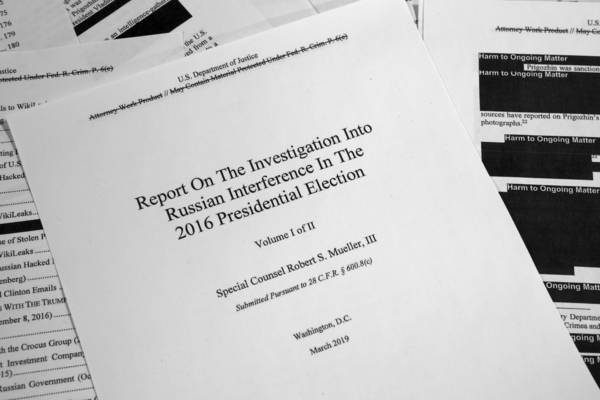
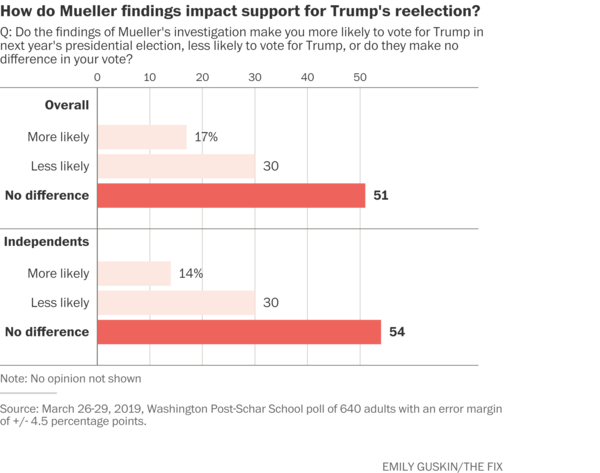
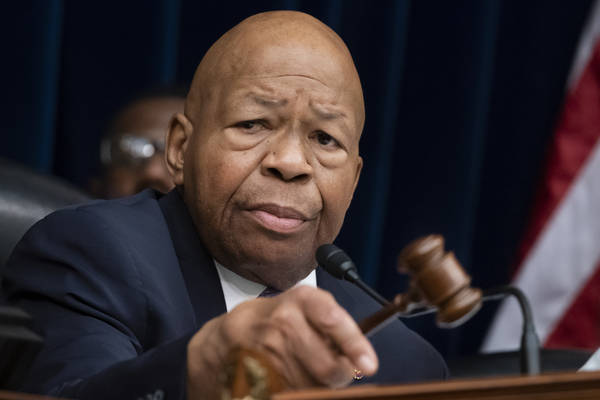
| House Democrats are having a conference call tonight to discuss a big decision: Do they pursue impeachment of President Trump based on the Mueller report or do they focus on trying to win the presidency? For many Democrats, it's one or the other. Here are the arguments they are likely debating at this consequential moment for the party. The argument for impeachment: Congress has to do something | Special counsel Robert S. Mueller III's redacted report on Russian interference in the 2016 presidential election. (AP Photo/Jon Elswick) | Even if the Democratic-House impeaches the president, no one expects the Republican-majority Senate to actually convict him and remove him from office. But still, if Congress doesn't act, what message will that send to future presidents? In Robert S. Mueller III's detailed report, information provided by some of Trump's top aides shows the president repeatedly tried to block an independent investigation. According to Mueller, Trump attempted to fire Mueller, then told his top aides to lie about it. Are there any consequences for a president who is hostile to the rule of law? "If the precedent created by the Trump investigation is that a president can fire a special counsel investigating a president, then the Rule of Law is doomed," Jens David Ohlin, the vice dean of Cornell Law School, said in a statement. The argument against impeachment: The right thing to do isn't always the politically smartest thing to do | 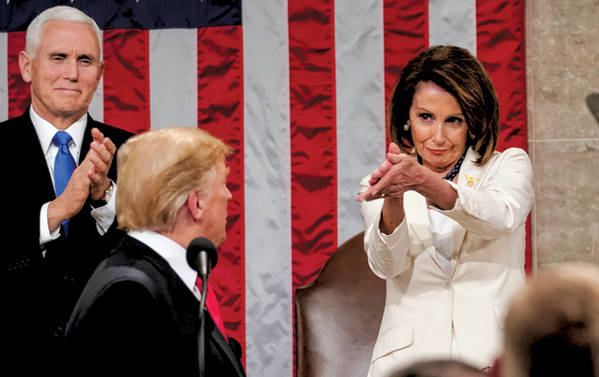 | House Speaker Nancy Pelosi (D-Calif.) claps as Trump begins his State of the Union address to Congress in February. (Doug Mills / The New York Times/ Pool) | Trying to get Trump out of office now could undermine Democrats' more realistic efforts to get him out of office in the 2020 election. They won control of the House last year by picking up seats in states like Oklahoma, Kansas and New Mexico. Democratic leaders like House Speaker Nancy Pelosi (D-Calif.) seem to think these voters care more about health care and jobs than theoretical questions about checks and balances. In a Washington Post-Schar School poll conducted last month, before the release of the Mueller report, half of the U.S. adults surveyed said the report will make no difference in their choice for president in 2020. | | | Meanwhile, Trump and his allies are merciless in their messaging that Trump is exonerated and that any efforts by Democrats to consider otherwise is purely politically motivated. While Democrats decide what to do, Trump will have had weeks' worth of head start to frame impeachment as ploy by Democrats. Do they risk feeding into that narrative by beginning impeachment proceedings? It's a tough call for Democrats. Inside the Mueller report Washington Post reporter Rosalind S. Helderman takes us inside the secretive conference rooms where the special counsel worked for nearly two years to figure out if Trump's campaign worked with Russians. Her takeaway: There were dead ends and uncooperative witnesses who made investigators' job quite difficult. Ultimately, Mueller concluded that the Trump campaign was at least open to Russian help but that there wasn't enough evidence to say they colluded with Russia. From her story: | Their witnesses were not ideal. A few key players, prosecutors would contend, lied in interviews. Many were loyal to the president and echoed his rhetoric that Mueller's team was acting in bad faith. Some used encrypted applications with disappearing messages that could not be reviewed. Others were overseas, unreachable to American investigators. In some cases, their statements were only loosely tethered to the facts. -Inside the Mueller report | | Trump's lawsuit against Congress, in context | House Oversight and Reform Committee Chairman Elijah Cummings (D-Md.) is being sued by Trump (AP Photo/J. Scott Applewhite) | House Democrats are pretty close to learning a lot about Trump's financial life before he was president. And Trump just threw a Hail Mary pass to try to stop them. On Monday he sued both his accounting firm and the chairman of the House Oversight Committee to stop the accounting firm from giving Congress 10 years worth of financial documents. The committee requested them as part of an investigation into whether Trump inflated his net worth to get loans to, say, try to buy the Buffalo Bills football team, or deflated it to get tax breaks. I've argued it's one of the most consequential congressional investigations into Trump because these documents could contain evidence of possible bank fraud. Trump's lawyers are arguing Congress doesn't have a right to investigate the president's personal finances just for the sake of investigation. But that ignores what Congress has been doing for centuries, said Josh Huder with the Georgetown University's Government Affairs Institute. Congress has oversight over the executive branch — hence the name of the oversight committee trying to get Trump's documents. It doesn't have to be focused on a particular piece of legislation to investigate something, he says. "Congress has a broad swath of power to get into anything it potentially wants to," he said, "and that includes things that are currently legislated and things that aren't currently legislated." The committee may still get the financial statements — just on a longer time frame than they had anticipated. That's the most notable takeaway of this lawsuit. | | | If you want to get The 5-Minute Fix in your inbox three afternoons a week, sign up here. And click here if you want to ask me a question about politics, send me a gif or give me a compliment. Still want more politics in your life? Read these awesome pieces:
| | | | | |










 Twitter
 Facebook


No comments:
Post a Comment