 | | We're missing parts of the Mueller Report, but we're not missing any copies of the Mueller Report (review). As soon as the redacted document appeared on the Justice Department website last Thursday, replicas started popping up all over in various formats — a testament not only to the public's interest but to the evolving mechanics of publishing. Bookstores with print-on-demand machines were probably the first to complete actual sales. Publishers Weekly reports that Shakespeare & Co. in New York and Harvard Book Store in Cambridge, Mass., began printing and selling physical copies "within hours of its release." The Washington Post edition (Simon & Schuster) took less than a week to produce, and it's No. 1 on Amazon. Alternate editions from Skyhorse and Melville House are not far behind on the bestseller list (Melville co-publisher Dennis Johnson offered a blow-by-blow Twitter report on his team's efforts to wrestle the Justice Department's PDF into something more readable.) Which brings us to those many "independently published" editions being hawked online. Beware: Some of these appear to be merely copies of the file that you can download for free. Meanwhile, to speed the recording process, Audible.com used three voice actors for its 19-hour audio version, released on Monday after what must have been a grueling weekend. Aside from the report's length, its redactions and footnotes pose unusual challenges for an audiobook, but the narrators do a good job of noting these elements as they recite this tale of chaos and deception. (Audible.com is a subsidiary of Amazon, whose CEO, Jeff Bezos, owns The Washington Post.) | 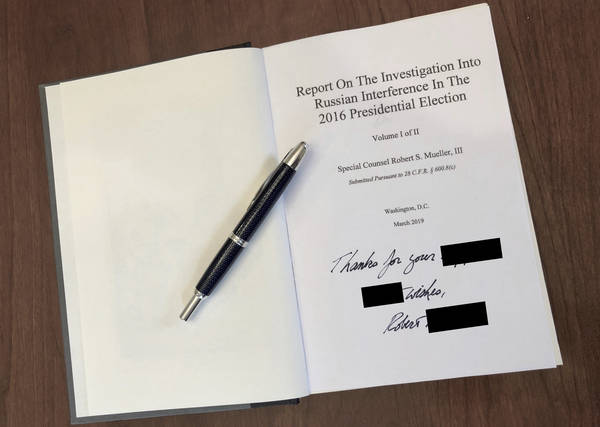 | For $1,000, I'll sell you this and a deed to the Brooklyn Bridge. | What would a signed copy of the Mueller Report be worth? I asked Ernest Hilbert, a rare book dealer in Philadelphia, to take his best guess. He rolled the question around a bit. "Who would get Mueller to sign it?" he wonders, noting that Mueller isn't an author in the traditional sense, nor will he be giving bookstore readings followed by signing sessions. "So, yes, probably a rare signature in its way. . . . Another question is who else has signed it? Members of his team? Could one slip it onto Trump's stack of 'items to be signed that day' so that he unknowingly signs one?" The problem, as Hilbert explains, is a lack of comparables. "I am guessing the demand for an item of such historical significance signed by Mueller would be high," he says. "For a collector of Americana, it's a must-have. The real test is if a copy went up at auction, so the market could decide. I wouldn't be surprised to see someone offering a signed copy for $800 or even $1,000. That's more than Trump signed books are commanding these days." NO EFFUSION! | 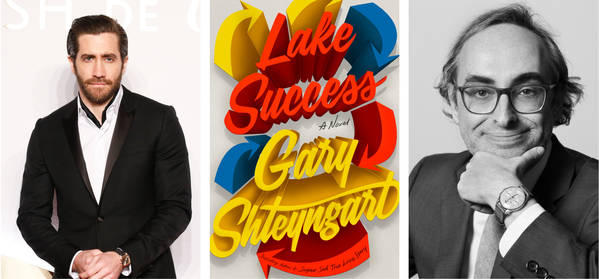 | (Jake Gyllenhaal photo by Julien M. Hekimian/Getty Images; Random House; Gary Shteyngart photo by Brigitte Lacombe) | Jake Gyllenhaal is set to produce and star in an HBO adaptation of Gary Shteyngart's "Lake Success" (review). According to Deadline, this limited series will mark Gyllenhaal's TV debut, and Shteyngart will co-write the script. "Lake Success," which was one of our 50 Notable Works of Fiction for 2018, is about a failed hedge fund manager who abandons his wife and little boy to embark on a wildly misconceived bus trip across America. "I love HBO and I love Jake Gyllenhaal. And I also love working in writing rooms," Shteyngart tells me. "It's so lonely being a novelist. I work in bed, next to a dusty fan and a 3-year-old copy of the New Republic I've forgotten to throw out for some reason. TV is a collaborative medium, and it's fun to hang out with a real brain trust. I'm working with a showrunner named Tom Spezialy on this. Tom did great work on Tom Perrotta's 'The Leftovers.' I think novels and HBO series go together like chocolate and peanut butter. Ooh, that's what I'm going to go get right now."
|  | | Independent bookstores were supposed to be dead by now. But a funny thing happened on the way to oblivion. Even as the so-called retail apocalypse spreads across America, the number of indie bookstores has been increasing since 2009, which calls for a party, don't you think? Saturday is Independent Bookstore Day, an annual celebration designed to highlight the economic and cultural contributions of America's indie bookstores. Almost 600 stores are participating this year with games, storytimes, live music, author readings and signed editions of new books, like Chuck Palahniuk's "Adjustment Day" and Miriam Toews's "Women Talking" (review). In some stores, you'll also find special Indie Bookstore Day merchandise, including a vinyl recording of Charles Bukowski reading selections from "Run with the Hunted," which is so hip it hurts. And in about a dozen cities, owners have banded together and designed something like a pub crawl that encourages readers to visit as many bookstores as possible for special discounts and prizes (San Francisco has produced this fun passport to Bay Area stores). Tayari Jones, author of the bestselling novel "An American Marriage" (review), is this year's Author Ambassador for IBD. "Independent bookstores have been a consistent force of good to me as a writer," she told me recently. "In the early years of my career, I wasn't exactly filling the seats. More than once, I would drive to an unfamiliar city, arriving at a bookstore road-worn and ready. There may have been only a handful of people there, but without fail, the bookstore staff welcomed me like family. They might say something like 'Don't worry about the small crowd. We believe in this book, and we will help you get it out there.'" Jones's experience is not unique; many authors you love depend on these stores to nurture their careers — and your reading life. Let the bookstore owners in your town know how much you appreciate them. | 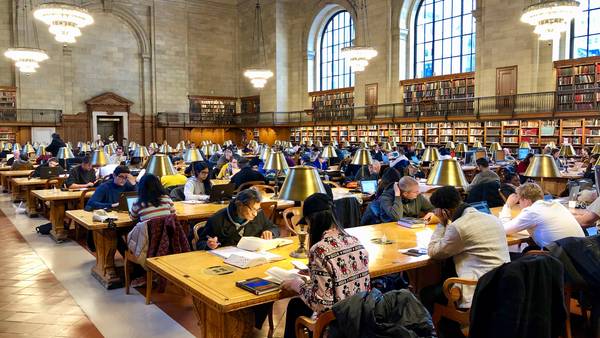 | (New York Public Library. Ron Charles/Washington Post) | | You're not just being a crank. Students nowadays really are worse than we were. That's the bad news from the Chronicle of Higher Education in a story called "The Fall, and Rise, of Reading," by Steven Johnson (story). He notes that "the typical 17-year-old now reads fewer pages for school than the typical 9-year-old." Disastrously, high schools have encouraged this decline by moving away from books to teach excerpts and snippets, the way one might ply a fussy toddler with Flintstones Vitamins instead of providing balanced meals. In college, the problem grows more complex. Far too many professors are in denial about how little their students are reading, and students have become cost-benefit experts about what assignments they most need to read. More alarming, almost two-thirds "reported not buying a textbook because it was too expensive," which makes me want to scream. But all is not lost. Johnson ends his story by talking with professors who are determined to teach their students how to read critically and equally determined to make sure they're doing it. Not surprisingly, the first recommendation is "tie reading to a grade," which can "double or even triple reading compliance."
| 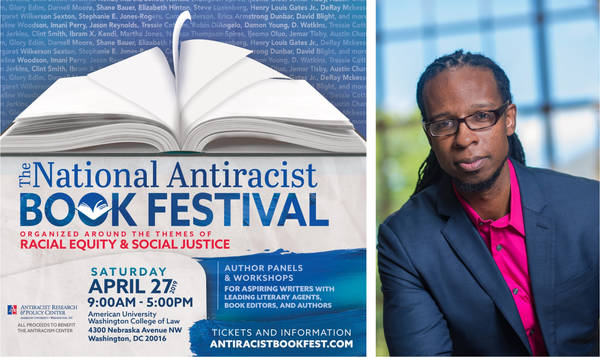 | (Ibram X. Kendi photo courtesy of American University) | The first Anti-Racist Book Festival opens Saturday in Washington. It's the brainchild of Ibram X. Kendi, who won a 2016 National Book Award for his revelatory history of racism, "Stamped from the Beginning" (review). The festival, at American University, will concentrate on anti-black racism and bring together prominent writers, scholars, literary agents and editors. Kendi notes that while most book festivals are "location oriented; few are issue oriented," and none is focused so specifically on this most central American challenge. During a recent interview on "The Kojo Nnamdi Show," Kendi explained, "Anti-racist books show the sort of beautiful imperfections of people of color, and they are not necessarily seeking to persuade away anyone's racist ideas. They're just trying to sort of show the stories of black people and other people as they are." Among tomorrow's scheduled speakers are Henry Louis Gates Jr., Jacqueline Woodson and David Blight. Buy tickets here. |  | An artist's rendering shows one of the entrances to the underground expansion of the Folger Shakespeare Library. (Folger Shakespeare Library) | Shakespeare is a man of considerable mystery, but we know he was baptized in Stratford-upon-Avon on this very day in 1564. Home to two Shakespeare theaters, D.C. is always ringing with the Bard's words, and the capital is particularly obsessed at the moment. Washington's Folger Library, which contains the largest collection of Shakespeare material in the world, has announced plans for a two-year $50 million renovation that will add large new spaces for public exhibits and scholarly research (story). A more inviting entrance is also long overdue. The neoclassical building, which opened in the 1930s, looks as impenetrable as a mausoleum. And speaking of preserved bodies, the Folger curators are scouring thousands of old books for microscopic scraps that could contain Shakespeare's DNA. Think of it as an Elizabethan version of "Jurassic Park." What could go wrong? Folger Director Michael Witmore explains Project Dustbunny (seriously) in the May issue of Washingtonian (story). And across the pond on the Guardian Book podcast, there's a great interview with Oxford professor Emma Smith about whether or not we're too reverent toward Shakespeare (listen). Among many irreverent insights, she points out that "Romeo and Juliet" is a play about premature ejaculation.
| 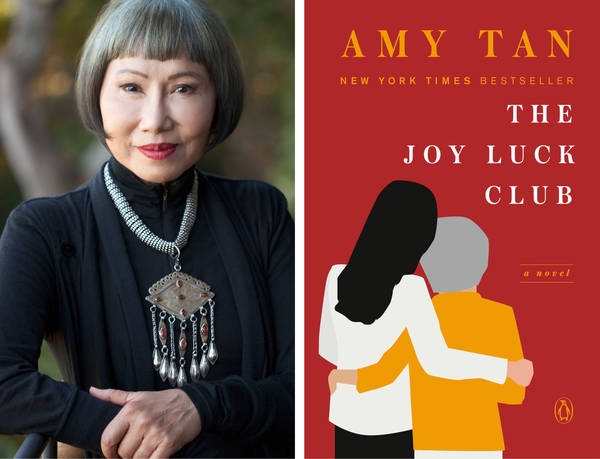 | (Amy Tan photo by Julian Johnson; Penguin) | In 1989, we published an enthusiastic review of a book by an unknown author: "Amy Tan's brilliant novel flits in and out of many realities but all of them contain mothers and daughters." Of course, now everybody knows that was "The Joy Luck Club," but Tan expected her debut novel would sit on bookstore shelves for a few weeks and "then disappear into the shredder." Hardly. The novel became a persistent bestseller and the basis for Wayne Wang's popular movie adaptation. This week, Penguin released a special 30th anniversary edition with a moving new preface by Tan (profile). "My mother was enormously proud of my first novel," she writes. "In one fell swoop, all the wounds I had inflicted on her had seemingly vanished. She, who recalled every slight I had committed from the age of six, now remembered my misdeeds with fondness. After I was published, she . . . would tell stranges, 'This is my daughter.'"
| | Stay in touch. If you have any questions or comments about this weekly newsletter or The Post's book coverage, contact me at ron.charles@washpost.com. If you know someone who would enjoy this newsletter, please forward it to them. To subscribe, click here. | | | | | |


 Twitter
 Facebook


No comments:
Post a Comment